
On this page
To register a sender ID if you have an Australian Business Number (ABN), your authorised contact or service of notice email address in the Australian Business Register (ABR) must be up to date.
We do not check Relationship Authorisation Manager (RAM) for authorisation arrangements for the SMS Sender ID Register.
Find out more.
Sender IDs
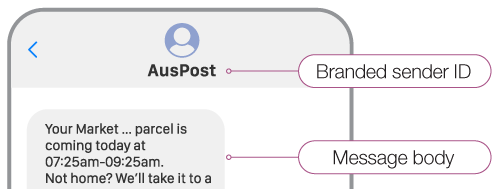
A sender ID is the branded name at the top of text messages from a business or organisation. It says who the message is from, like ‘ATO’, ‘AusPost’ or ‘myGov’.
Apply now to register your sender ID
Register your existing sender ID as early as possible before 1 July 2026. If you don’t, your text messages will be labelled as coming from ‘Unverified’ from 1 July 2026.
Apply now – the sooner the better to allow time for your sender ID application to be processed and approved. Last minute applications may not be processed by your telco or message provider in time.
If you have questions about a current sender ID you have in use that has not been registered, or may not be registered before 1 July 2026, please discuss options with your telco or message provider.
We strongly recommend acting now to so that your sender IDs are approved as soon as possible.
If you don’t use a sender ID, or you send messages from a phone number, you don’t need to do anything.
Why register and use sender IDs?
From 1 July 2026, your customers can be more confident that any SMS or MMS you send have come from you.
Using sender IDs also helps customers spot scams. When customers know that you will only contact them via text messages with a certain registered sender ID, they know to treat messages from phone numbers or those marked ‘Unverified’ with caution and report them if needed.
Using a registered sender ID makes it harder for scammers to impersonate your organisation, reducing the risk of reputational damage, customer confusion and disruption to your communications.
How to register your sender ID
There are different processes depending on if you have an Australian Business Number (ABN) or not.
Find out how to register a sender ID if:
If you don’t register your sender ID
If you don’t register your sender ID in time, it will be replaced with the word ‘Unverified’ from 1 July 2026.
All texts from ‘Unverified’ senders will be grouped together in the same message thread on people’s phones, indicating to them it may be a scam.
If you want to stop using sender IDs, you should talk to your telco or message provider.
Who can register sender IDs
Australian and international businesses and organisations can register sender IDs.
There are steps you must follow to prove you are a legitimate business or organisation. These steps help to stop scammers using the register.
You can register sender IDs if you are:
- an individual
- a body corporate
- a corporation sole
- a body politic
- a government entity
- a partnership
- any other unincorporated association or body of person
- a trust
- a superannuation fund.
Find out how to register a sender ID if:
Types of sender ID you can register
Restrictions and criteria
Sender IDs must meet specific criteria before they can be registered.
A sender ID must:
- only consist of letters, numbers and symbols – these should correspond to decimal codes 32–126 from the American Standard Code for Information Interchange (ASCII) standard
- be at least 2 and no more than 11 characters long
- not consist only of numbers
- not contain a space or underscore at the beginning or end of the sender ID
- not contain the word ‘Unverified’
- not contain a word or words that are offensive, deceptive or misleading, using the commonly understood definitions of those terms
- not solely consist of a restricted word or words.
Sender IDs are not case sensitive (for example, ‘ABC’ is considered the same as ‘abc’).
A sender ID can be registered and used by multiple organisations if each organisation can prove it has a valid use case.
Linking your sender ID to your organisation
Your sender ID must also be clearly linked to your organisation. This helps your customers recognise who the message is from and reduces the risk of confusion or impersonation.
You can register a sender ID that:
- is the same as your organisation’s name, or a shortened version (for example, ‘Australia Post’ → ’AusPost’)
- is an acronym or initialism of your name (for example, ‘Australian Communications and Media Authority‘ → ’ACMA’)
- also includes extra words that relate to your organisation’s role, location, or the purpose of the message (for example, ‘ACMA Alerts’).
If you have an ABN: your sender ID must match your organisation’s registered business name, company name, trademark or domain name.
If you don’t have an ABN: your sender ID must match your trademark or name on an official register or record in the country in which your organisation is based.