
On this page
How we encourage compliance and respond to rule breaches
The ACMA’s purpose is to contribute to maximising the economic and social benefits of communications infrastructure, content and services for Australia. This includes maintaining, enforcing and improving regulation to drive industry performance and protect consumers.
Compliance and enforcement actions are important ways we work to achieve our purpose.
This policy sets out the ACMA’s general approach to compliance and enforcement. It explains that we encourage those we regulate (regulated entities) to comply with their regulatory obligations. It also outlines that we take action if they don’t.
The ACMA's role
We are Australia’s regulator for broadcasting, radiocommunications, telecommunications, unsolicited communications and certain online content (including interactive gambling). We carry out compliance and enforcement activities under the provisions of the:
- Broadcasting Services Act 1992
- Radiocommunications Act 1992
- Telecommunications Act 1997
- Telecommunications (Consumer Protection and Service Standards) Act 1999
- Telecommunications (Interception and Access) Act 1979
- Spam Act 2003
- Do Not Call Register Act 2006
- Interactive Gambling Act 2001
- instruments made or registered under these laws.
Some legislation (for example, the Spam Act) sets out our enforcement powers in full. In some cases, the Regulatory Powers (Standard Provisions) Act 2014 also details relevant powers.
The legislative schemes for broadcasting and telecommunications include areas for ‘co-regulation’ that enable representative industry bodies to develop codes of practice. These codes establish rules that industry participants must follow and must be registered by the ACMA before they come into force. In specific circumstances, we can also make mandatory standards.
Our compliance and enforcement approach
We encourage a compliance culture within the industries we regulate. We take action to ensure community safeguards are upheld and laws adhered to.
When a regulatory breach is identified, we take regulatory action that reflects:
- the seriousness of the breach
- the level of harm caused to individuals or the broader community.
Compliance and enforcement responses
We use a range of compliance and enforcement responses, depending on which piece of legislation or co-regulatory code applies, to drive a culture of compliance. This is shown in our compliance pyramid below.
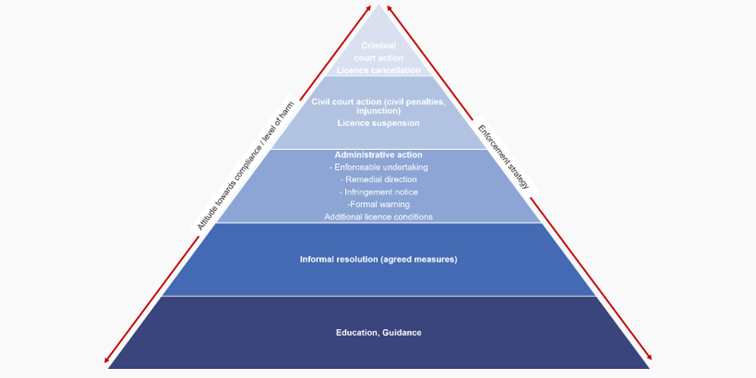
Our compliance and enforcement powers are graduated, ranging from informal resolutions and administrative warnings through to seeking civil or criminal penalties in court.
We base each of our compliance and enforcement decisions on the facts within the context of the relevant regulatory framework. We also consider whether:
- the conduct has caused, or may cause, harm to another person, and the nature, seriousness and extent of that harm
- the conduct was deliberate, inadvertent or reckless
- the action will stop unlawful conduct or whether there are systemic issues that may pose ongoing compliance issues (so that another action is necessary)
- the action will deter future offending conduct by the relevant entity or other regulated entities, or the educative effect of the action
- the compliance history of the regulated entity, including whether it has been the subject of prior compliance or enforcement action and the outcome of that action
- whether the entity has co-operated with the ACMA during its investigations
- any action has been taken by the regulated entity to remedy and address the consequences of the conduct
- court orders are needed to penalise the conduct or to clarify aspects of the law.
Education and agreed measures
We encourage industry compliance, including by providing guidance material, particularly when new regulatory requirements are introduced. We also issue compliance alerts to remind or encourage industry participants to address or avoid compliance issues that may arise.
To informally resolve a compliance issue, we may accept a written commitment (commonly called ‘agreed measures’) that specific actions will be taken by the regulated entity to address non-compliance and ensure future compliance.
We also provide information, advice and resources for the community to inform them about entity non-compliance, their rights and how the ACMA (and others) can help.
Investigations
We have statutory powers to conduct investigations to establish facts, determine whether there have breaches of regulatory obligations and, if so, decide on further actions to be taken.
We may compel evidence under statutory notices and we expect timely and comprehensive responses. Compliance with statutory notices is mandatory; failure to comply can have serious criminal or civil consequences.
We publish investigation reports on our website to promote transparency and accountability and to signal our expectations to the industry sectors we regulate.
We balance this by providing procedural fairness to the regulated entities (and individuals) identified in investigation reports. It is an explicit requirement under some of our legislation that if publication would be likely to adversely affect someone’s interests, the ACMA must give that person an opportunity to make representations. We provide those under investigation with an opportunity to consider the final report or associated material before publication to identify any factual errors.
Administrative action
When we identify non-compliance, we may take formal administrative action. Our administrative powers of enforcement differ under the legislation we administer.
- Formal warnings: In certain instances, we can issue a formal warning that places an entity on notice that we have identified issues of concern and provides an opportunity to address those issues. It also warns them that stronger enforcement action may be taken if the non-compliance is not rectified, or it recurs.
- Infringement notices: We can also give an infringement notice for certain types of contraventions. If the recipient chooses to pay the specified penalty, their liability for the alleged contravention is discharged. If they do not, we will consider other enforcement options, including the commencement of court proceedings.
The amount payable in an infringement notice may be significantly lower than the maximum penalty that a court could impose for the alleged contravention. However, infringement notices can allow timely and effective dispute resolution without the need for litigation. - Court-enforceable undertakings: We may also accept court-enforceable undertakings from the relevant regulated entity. This is a formal promise to act, or refrain from acting, in a particular manner. For example, an enforceable undertaking may commit to investing in systems and introducing improved processes to ensure future compliance. The costs of complying with the enforceable undertaking are borne by the party giving it. The ACMA cannot compel a regulated entity to offer an enforceable undertaking.
We may use acceptance of enforceable undertakings alongside other actions, such as issuing an infringement notice.
If the terms of the enforceable undertaking are not complied with, we may begin proceedings in the Federal Court. - Remedial directions: These are given in writing and direct the regulated entity to take specified action aimed at ensuring that the breach is remedied or that it is unlikely to recur in the future. There are significant consequences for an entity that does not comply with a remedial direction, including civil penalties that can be enforced in court.
- Code directions: We can direct a person or regulated entity to comply with an industry code if we are satisfied that they have contravened or are contravening the code. Failure to comply with a direction may amount to an offence under the relevant legislation.
- Licensing: In sectors where parties operate under licences or authorisations/accreditations we administer, we have the power to impose additional conditions, suspend a licence or, in the more serious matters, cancel a licence or withdraw an accreditation/authorisation.
Court actions: civil and criminal
Beyond administrative action, we can also initiate court proceedings to pursue civil penalties or refer the non-compliance to the Commonwealth Director of Public Prosecutions (CDPP) for prosecution of an offence.
For certain contraventions, we have the power to begin civil proceedings to obtain civil penalty orders, injunctive relief, orders for the forfeiture of illegal equipment or orders to enforce an enforceable undertaking. We follow the Commonwealth’s model litigant rules when contemplating or conducting litigation.
Some of the laws we administer also create offences. The office of the CDPP prosecutes these offences. The ACMA can refer a matter to the CDPP for prosecution of an offence after considering all the facts and circumstances and the Prosecution Policy of the Commonwealth.
Co-operation and self-reporting
We encourage regulated entities to self-report potential breaches to us. We also encourage cooperation with our investigations. These matters are taken into account when enforcement action is considered.
Review of ACMA decisions
We aim to be transparent in our decision-making. In communicating our decisions, we identify the decision that has been made and the basis for the decision, including evidence relied upon to make findings of fact.
Merits review of some ACMA decisions may be undertaken by the Administrative Review Tribunal but only where expressly stated in legislation. Judicial review of some ACMA administrative decisions may be undertaken by the Federal Court under the Administrative Decisions (Judicial Review) Act 1977.
The Commonwealth Ombudsman has powers to investigate complaints about actions taken (or not taken) by the ACMA.
We are also accountable to the Parliament through our annual report and responses to parliamentary questions.
Further information
Read about our compliance activities and approaches in our:
- Corporate plan
- Annual report
- Regulatory guides
- Investigations and compliance reporting
- Infringement notice guidelines issued by the ACMA under subsection 572(2) of the Telecommunications Act 1997
- Enforcement guidelines issued by the ACMA under section 215 of the Broadcasting Services Act 1992.