
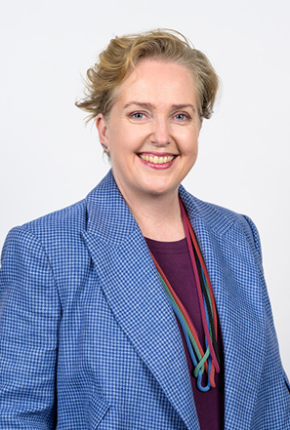
ACMA Chief AI Officer Samantha Yorke joined Prue Bentley on ABC Victoria's Statewide Drive Program on 11 March 2026 to discuss her appointment as the ACMA’s inaugural Chief AI Officer.
Interview audio
Interview transcript
Prue:
Samantha, good afternoon.
Samantha:
Hi Prue.
Prue:
So what does a Chief AI Officer do when it comes to ACMA?
Samantha:
So it is a new role, Prue, and it is a role that all Australian public service agencies will have to appoint within their agency. The idea being that this will set up a community of people that are very focused on adoption and advocating for change within each of their agencies. So we'll work together, we'll share information, best practice and learn from each other. But in the context of the work that we do here at the Australian Communications and Media Authority, we'll also be thinking about how we modernise our workforce. We don't think about this as being just an IT rollout, it's very much a change management process. Much like in the broader community, there are mixed feelings within our agency about using AI – we need to be sensitive to that – but we also recognise that as a government agency, we need to play a leadership role in embracing AI for the benefit of all Australians. But also making sure that when we use it, it's safe, ethical and responsible to use it, in line with community expectations.
Prue:
When you were appointed, were there some nervous people within the ACMA thinking, well, they're going to bring in AI, my job is gone, is that the feeling here?
Samantha:
Well, I think just like everywhere, I think we're all, you know, keeping one eye on our job descriptions and thinking about the future and the skills that we have and whether AI will one day replace those. But we've made really clear to our employees here at the agency, that we are embarking upon this as a change management program that’s really about augmenting our workforce, not replacing them. And we're also very sensitive to this idea of de-skilling, Prue, which is, you know, human capabilities being diminished when they depend too heavily on AI.
Prue:
Is this kind of like when you stop using maps and you start using computer maps? You pull out a map and you think I cannot even work out which way is west.
Samantha:
That is a great analogy. And we're very alive to people feeling like they're going to lose certain skills and human capabilities if they're using AI too much. So, we're really trying to encourage people to experiment, but to also be very mindful about when and how they're using AI.
Prue:
You're no stranger to this space, Samantha. You've come from Google. I know you've worked in a lot of tech companies over the years. Are you optimistic about AI and how it will be adapted for use in different industries, or do you have concerns about the pace of the rollout?
Samantha:
So, Prue, I feel like I sit somewhere in the middle and I think it's probably healthy for all of us to appreciate the potential benefits that AI will offer, particularly in areas like healthcare and medical diagnosis, but to also be clear eyed about the risks as well. And I think it would be healthy for all of us to adopt that balanced point of view. But you know coming from a tech background, I do have a natural inclination towards tech optimism, but also just being very mindful of all of the work and the resources and the efforts that go into identifying and trying to mitigate these risks at the outset.
Prue:
Now, I mentioned at the beginning of this that the media industry is one of those that has, I think, a lot of opportunities, but also a fair bit of scepticism around whether you know, a lot of jobs that are done – like mine, for example – could be done by AI. I know that you are mostly an internal role at ACMA but you must have one eye on the landscape of the industry at the same time?
Samantha:
We absolutely do. And I don't think we'd be doing our jobs well if we weren't consciously thinking about how the industries that we regulate are using AI in their business. We've been trying to talk openly with those industries, to encourage them to share with us how they're using AI and to have just a dialogue really, about how we as the regulator can help support them in their efforts to use AI. For instance, we've recently registered the Commercial Radio Code of Conduct, Prue, which includes a provision which forces radio stations to disclose when they're using a synthetically produced voice as the host of a program. So we're not saying you can't do that, but we are encouraging them to be transparent, to disclose when they're using AI, and to really establish that as a best practice. And we'd love to see that emulated across all of the industries that we regulate.
Prue:
So that is a really good example of a code being updated. But a lot of the regulation is currently voluntary. Should it be mandatory to have safe and ethical practices?
Samantha:
Well, I wouldn't say that the codes are voluntary Prue. The process is that industry draft codes and they then submit them to us to be considered and potentially registered. Now, you may be aware that last year the free-to-air television industry updated their code, submitted it to us for registration, and we actually declined to register that code because we didn't think that it provided adequate community safeguards. But the Commercial Radio Code, for instance, we did register. So there is an element of co-regulation there, whereby industry develops some rules they think meet the standards that we expect and the community expect. And then we decide as a regulator whether those rules meet those standards. And then if a company decides to breach the code that applies to them, we have certain enforcement tools in our toolkit that we can use to remedy the breach, but to also encourage future compliance. Because our goal at the end of the day is to support industries to comply with the laws that apply to them, rather than to be constantly wielding a big stick.
Prue:
It is interesting though. I mean, we're doing this in Australia and I think we can take heart from the fact that there are roles like yours looking at the guidelines, looking at the safeguards. But we also live in a global media environment, where those safeguards aren't going to be universal. Is that, do you think that's going to be a problem?
Samantha:
It has become a problem for regulators in the digital age, Prue, I won't lie, where you know we're often regulating businesses that are global businesses and that operate in many countries around the world, of which Australia is one. Now, companies that are operating here in Australia clearly need to comply with Australian laws. But what we try to do as a regulator is work with the industries themselves, but also work with regulators in like-minded countries. So we have a great relationship with Ofcom, for instance, in the UK, where we regularly talk and exchange information about what we're seeing and what regulatory tools are working well, what's not working so well. And we do have an eye to trying to develop, what we call coherent regulatory frameworks, where there aren't huge inconsistencies, which obviously make it harder for global businesses to comply with all of these laws. So we have similar values across countries like the UK and Canada and New Zealand, so we try to enact regulatory frameworks that are roughly consistent so that we establish some global norms in these areas.
Prue:
There could be a lot of breaches. That could be a lot of work for ACMA?
Samantha:
Yes, which will keep our people in jobs, which is great. But, you know, as I said earlier, our goal is not to constantly be breaching people and imposing penalties upon businesses. Our goal is really to help businesses comply with the laws that exist and to help us design new regulatory frameworks that meet these new challenges.
Prue:
Samantha, congratulations on your new role. Thank you so much for talking us through it today. As you say, many, in fact, all government departments are going to have a similar role to yours. It is a brave new world that we are embarking on.
Samantha:
It is. Thank you, Prue.
Prue:
Samantha Yorke is the new Chief AI Officer at the Australian Communications and Media Authority, the ACMA. So Samantha is kind of looking at the internal workings, but also looking outside.